|
|
home | the sheep
| Lanaset
dyes | Lanaset
Rainbows | our fiber
project
photo gallery | fiber
exchange notebooks |
links
Chanticleer Shetlands
from
Sheep Hollow Farm and Fiber
When we purchased our first Shetland sheep, we were asked to pick a flock prefix. This is usually the farm or shepherd's name. We requested the use of "Sheep Hollow" Shetlands, however there is another flock registered as "Sheepy Hollow" Shetlands. Owens' Shetlands didn't have the right ring to it and so we chose "Chanticleer" as our prefix. Sheep Hollow is home to the Chanticleer Shetlands.
First a Bit About Shetland Sheep in General
Shetland Sheep were first imported into the United States in 1986 and nearly all of the Shetlands in the U.S. are offspring from this importation and two earlier Canadian ones. Current health issues creating closed borders, makes it unlikely that new animals will be imported in the near future. Today, with the availability of artificial insemination using imported semen, American bloodlines are being diversified with genetics from the United Kingdom.
The Shetland breed was once on the endangered list. However, the Shetlands' size, hardiness, general friendliness and wonderful wool has made them quite popular with handspinners and conservationists and they are no longer considered threatened but have been categorized as a minority breed with the Rare Breeds Survival Trust.
For a detailed history of the Shetland breed, check out our "links" page and go to either the NASSA (North American Shetland Sheepbreeders Association) web site or the Oklahoma State University, breeds of sheep web site.
Shetlands are small with rams weighing 90 to 125 pounds and ewes weighing 75 to 100 pounds. They produce two to six pounds of wool per year. The wool can be any color—from white to black, from fawn to chocolate. The breed standard lists 11 colors and 30 different marking patterns. Shetland wool comes in a variety of textures as well, anything from short-stapled and crimpy to a true double coat with a soft, downy undercoat and long hair-like (but wool) outer coat. It would appear that Shetlands offer a fleece and color for every spinner!
Retaining many primitive qualities, some Shetland sheep will naturally shed their fleece in spring. The wool slows its growth in winter and in the spring new growth resumes. The point at which new growth occurs is called the rise and is a tender spot in the fiber, making it easier for shepherds to roo or pluck the wool from the sheep. For today's shepherds it makes shearing a bit of a guessing game ... that is to try to shear either just before the rise or just after it. When shopping for Shetland fleece, purchasers should be aware of this and look carefully at fleeces labeled "early shedding." Such fleeces could have a break in the staple or be somewhat felted at the tips or cut end, depending on when shearing took place in relation to the time of the rise.
The Rise
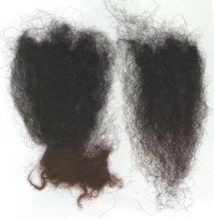
These two photos illustrate the rise. Both display locks of wool with the cut/shorn end at the top.
On the left, the previous year's shearing occurred before the rise. Notice the felted brown tips created by the rise. The right most portion of this lock has been pulled from the felt and will spin-up nicely.
On the right, the previous year's shearing occurred after the rise, note the slightly felted fiber at the top (cut-end) of the locks. A break can be seen where the winter slowing of wool growth occurred. Wool from this fleece would be best prepared with combs..
mid summer 2001
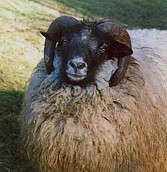
Daphne, Fiona's dam
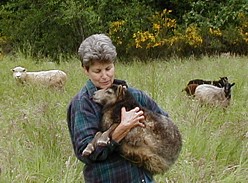
Fiona at about 2 weeks Romeo, Fiona's sire
Fiona at about 2 months Fiona as an adult
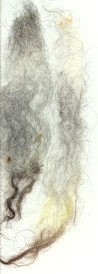
Color ChangesDaphne was born tri-color but basically black/dark charcoal with white and light tan markings and soon faded to silver. Still showing areas of light tan, shades of gray and black, as an adult Fiona became mostly ivory. Her dam was born black and at maturity had faded to lovely shades of silver. Romeo was born black-spotted and became nearly white at maturity excepting his face, legs, tail, mane and dorsal stripe which are black fibered. Fiona now has a badger face.